

Good morning,
girls, we’re in prison
On February 24, 2022, Nadia took to the streets to express her despair
and dissent and ended up in prison.
Nadia shared her experience and showed the diaries
she kept throughout her time in prison.
Why am I telling this anonymously?
My life has turned out in such a way that I no longer live in Russia, but I still have family there whom I want to continue visiting. I can’t say for sure what the authorities and, in particular, state structures might do to me for participating in some peace-building, peace-promoting, peace-motivated projects, I’m playing it safe and telling this story anonymously. Plus, my experience is not unique — many people in Russia are going through the same thing right now. And for me it’s more important to tell what it was like from my perspective, so that someone will recognize themselves in it.
Protests 2022. Non-dangerous violence
After February 24, 2022, I went to a protest and committed “non-violent assault” against a representative of the authorities. It is what it’s called in the Criminal Code of Russia. In prison circles it’s shortened to “assaulting an officer”. Why did I choose such a way to protest? It’s hard to say, because I had no intention to hurt an officer. My goal was to express my desperation, because I remember reading the news on February 24 and picturing my children and grandchildren, on whom I bear the burden of responsibility, right before my eyes. I didn’t want to shift [the responsibility] onto them, I didn’t want them to ask me questions about what I had and hadn’t done to influence the situation. I was desperate. Emotionally I had two choices, two options: either I would go to the streets to protest, or I would jump out of the window. And I decided that I would probably go out to the streets after all.
Usually people are gathering [for protests] on Tverskaya Street in Moscow, and I just knew that if something was happening, I had to go to Tverskaya — that’s where everything usually happens. My friends sent me some announcements, and in the end they didn’t go to the protests. And I’m glad, because maybe I wouldn’t have done it if someone had been with me. But it was very important for me to express my disagreement and make my position clear.
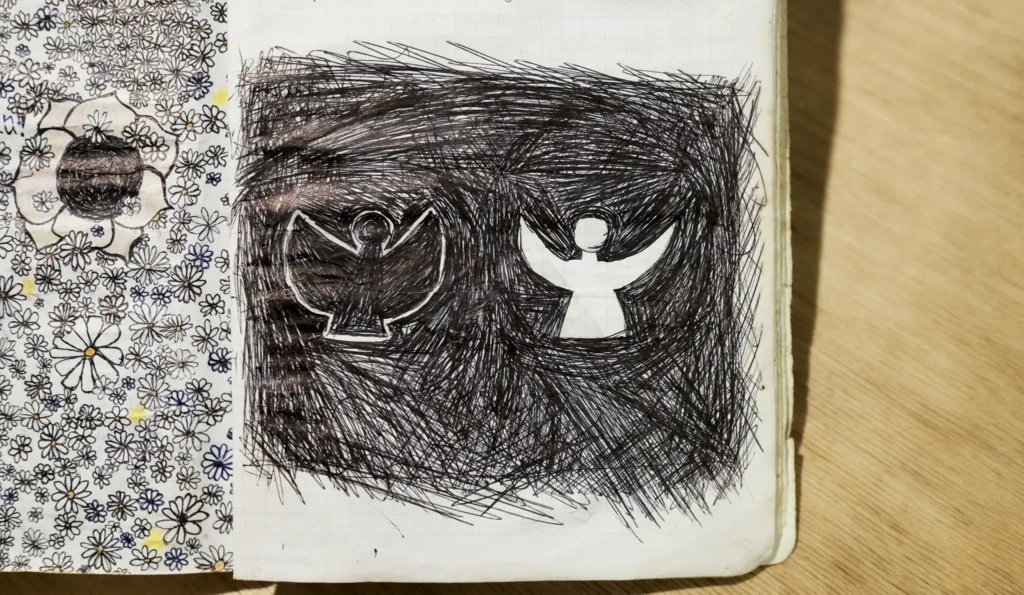
a drawing from Nadia’s diary
Arrest
I was arrested right away, I did not run away and did not resist. Initially I knew perfectly well that it was a criminal offense. What’s more, the sentence I was given was completely different from the one I imagined in my mind. I was counting for eight years, but in the end, it turned out to be less than two.
First, they put me in a regular police van. Then they came back and said: “Damn, you’re a criminal, we’re catching “administrative offenders” right now, and you’re a criminal, so get in another car”. I rode comfortably in a Toyota car to one department, then to another, and then to a temporary detention center. I don’t remember that time very well because it all blended into one endless day until they brought me to the pretrial detention center. And then I spent a year in the detention center, and during that time, I didn’t see the sky without bars, because the courtyards for walking are covered. The detention center is generally considered a strict place of detention, so everything is covered there, you walk with handcuffs, with your hands behind your back.
When I saw the sky in the colony it was such happiness. All those days I spent there, I couldn’t get enough of it. There is such a beautiful area in general. I really enjoyed nature. It’s interesting how your own mind learns to free yourself from imprisonment.
They put you in jail, they punish you, but you still find a way to be happy, to enjoy yourself. And I remember one moment very well: I am standing, waiting for the commissary (there is a kiosk inside the colony, and you can visit it twice a month. You stand there with the whole group, waiting your turn). And nearby, women are gathering mushrooms to make a pie out of mushrooms, lavash bread, and some canned food. In prison life goes on, and it’s your life, it’s not someone else’s. It is impossible to put it on pause and you should not do it.
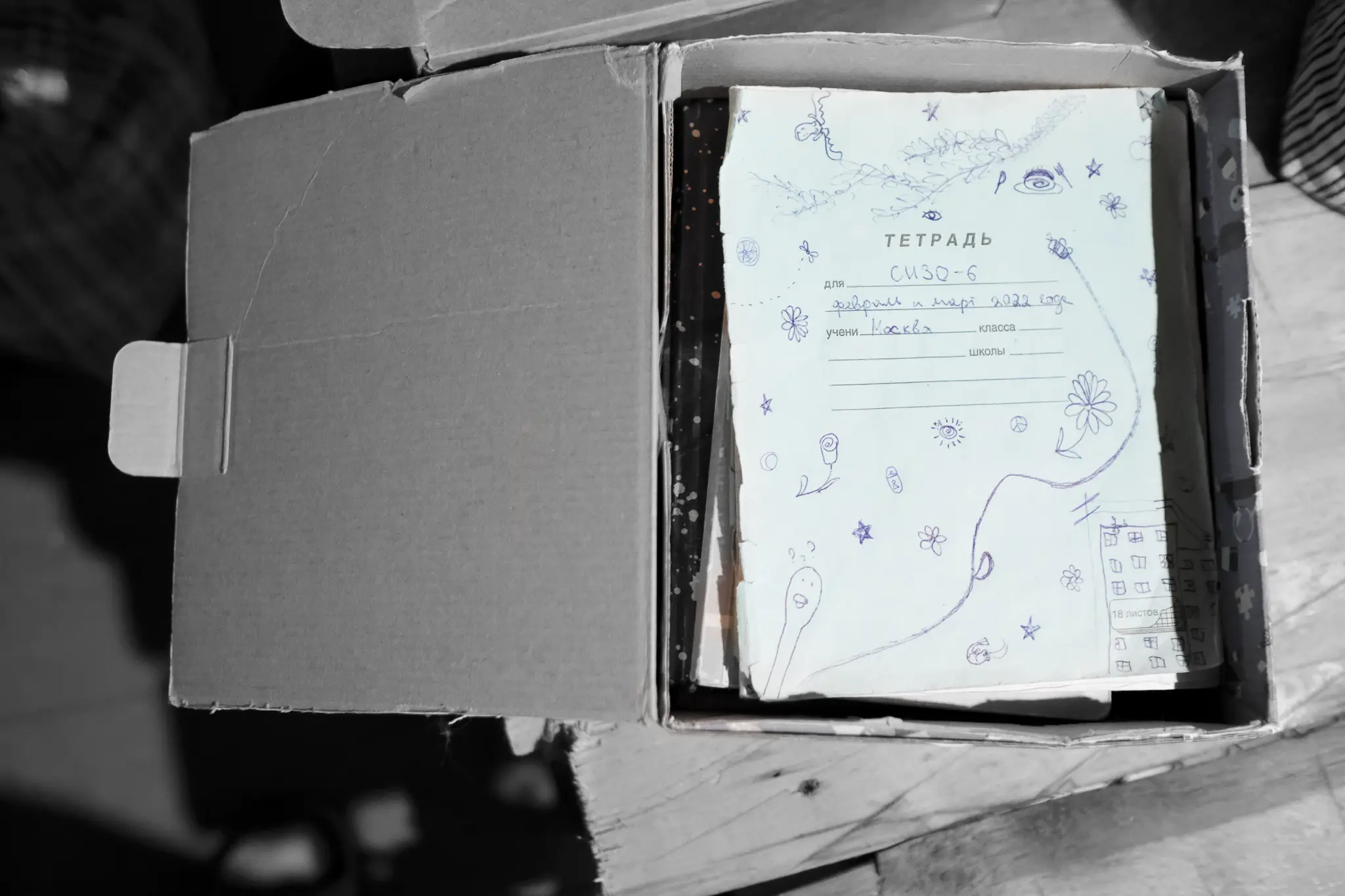
notebook / detention center – 6 / February and March 2022 / Moscow
Violence, hygiene, cigarettes
I wasn’t tortured, if we’re talking about that, but from my point of view, all the conditions of detention in the pre-trial detention center and in the colony are torture. But they did not hang me by my feet and did not shove a wire somewhere… The hardest thing for me was (I realize this sounds silly now) when they wouldn’t let me go to the toilet or give me anything to drink for a long time — that was hard.
They give us, like, 10 pads per month. And, what’s more, they may not do it regularly. For those who don’t know, that’s not enough. In colonies and prisons, there is a practice where girls work for cigarettes, doing household chores for you. But because of the situation with hygiene kits, some have to work for sanitary pads [as payment]. They do your laundry, stand in line for the medical office, make coffee, and so on. And all this for one or two pads. And that’s on top of primary work in production and the fact that they won’t leave you alone in the living area either, and in your half an hour of free time you can’t lie down or sit down.
Yes, it’s funny, but you can’t sit down in the colonies. During the day, you can’t sit on anything that isn’t a chair, and there are no chairs. There are only chairs in the teahouse – it’s a small corner with a refrigerator and tables. But there are only 12 seats, and there are 60 of us in the squad. And by the time the old-timers, 100-percenters, the administrative staff, such as the day guards, the brigadiers, and someone else… In general, by the time your turn comes, the allotted time for ‘drinking tea’ will be over.
Starosidy (old-timers, long-term prisoners) — those who have been serving for more than 3 years;
Sotochnitsy (100-percenters/quota achievers) — seamstresses at the enterprise who meet their quota 100%. That is, seamstresses with maximum efficiency. This is very difficult to achieve, as it requires working non-stop. Thanks to the seamstresses, it is often possible to meet the monthly quota for the number of items produced, so the desire to achieve the maximum percentage of the quota is welcomed both by the administration (more production means more money) and by the prisoners (more production means less hassle from the administration). The administration issues letters of gratitude, which can then be used in court to replace the punishment with a lighter one, and among the prisoners, it is customary for them to be allowed to skip the queue in the shop and have access to the benefits usually enjoyed by starosidy and appointed prisoners (duty officers, foremen, etc.) such as bidets, better-maintained toilets, tables reserved only for “blatnye” (prisoners with connections), and so on;
Dnevalnye (day guards) — appointed prisoners, in charge of matters concerning the squad in the residential zone;
Brigadirka (brigadier, brigade leader) — oversees the industrial zone and is the head of the squad, the brigade;

Fools are lucky (I hope)
Penalty system
There is a penalty system in prison, which can prevent you from applying for a lighter sentence or even early release. They can penalise you for literally anything, even for a tag that isn’t sewn on. Everyone walks around with name-tags on their chests and everyone covers it with plastic so it doesn’t get damaged, because it’s just a piece of paper. The tag needs to be sewn on on all four sides. If it is sewn on three sides and the administration sees it, they can impose a penalty.
If your headscarf is tied badly, damn it (the culture of headscarfs in prison should die, because, well, damn it, headscarfs!), it means you look untidy. They gave me a completely torn skirt, and then they reprimanded me for it because I had to look neat.
The uniform is terribly uncomfortable – these pencil skirts, cold coats for freezing winters, four pairs of underwear with 12-14 hour workdays at the factory. There’s a rumor that this set was designed by Tereshkova, and she is very much disliked for this in the colonies.
Everything is green. Uniform is even called brilliant green [referred to medicine]. For demiseason and cool summer you have: two shirts, one jacket, one skirt, and two pairs of tights. You can have four pairs of underwear, five pairs of socks, and two bras. You do your laundry once a week. Obviously, everyone washes their clothes in the sink because everyone wants to live like a human being. Officially you are allowed to have very few clothes. If you have to wash your sweater in winter, you don’t have a second one to replace it, and you walk around in a thin shirt and a poorly made jacket, freezing. And if along with the sweater both of your shirts are also dirty, you walk around in winter in a sheepskin coat and a thin summer robe for the entire laundry day. And trousers are not allowed. I don’t know about other regions, but where I was, there were no trousers, including for winter. At the same time, this is north of Moscow and the winter there was harsh.
Beatings. Red and black.
The places I have been there were no beatings from administration. The women fought among themselves, sometimes the fights were uneven, but there was no beating. First of all, all women’s colonies are red. Colonies are divided into two types: black and red. Criminal authorities rule in the black ones, the administration there is a mere formality. And everyone there lives by the rules of the criminal world.In the red zones administrative orders prevail. All women’s zones are subordinate to the administration, and you will only be beaten there if the administration gives its approval. In my colony such practice was not a case, for example. I’ve heard from people who were transferred (sometimes inmates are getting transferred from one colony to another) that in some places they were beaten, they got jumped. This is when they are taken to the toilet (the only place where there are no surveillance cameras) and beaten there. Without evidence there was no crime.
But in my experience, women seem to be more prone to psychological violence. Perhaps this is because we are brought up that it is not proper for women to show open aggression, which is why there is a lot of psychological violence. Therefore there are more psychological traumas than physical.
Roles
There are several intermediate roles for prisoners who work for the administration, and this is officially legalized.
There is a brigadier — this person oversees the industrial zone and is the head of the brigade.
There is an accountant, I don’t remember what it was called in our case… a person who is responsible for the final product of production.
There are day guards — appointed prisoners, in charge of squad matters in the residential zone. They monitor cleanliness and order (making life difficult for those who do not clean up, keep prohibited items, etc.), resolve and initiate conflicts, pass on information from the administration, compile lists and report on the inmates of their squad to the administration. This goes into their character reference as a positive role, and the administration treats them loyally. So if a day guard wants to beat someone up, no one will have any complaints about it.

“If anyone had taken me by the hand, I would have immediately burst into tears. 14.03.22, 05:44”
People and humanity
Sometimes you don’t want to open your eyes in the morning. Everyone is so annoying: terribly angry, tired, so nasty. You live with the people who don`t need you, and you don`t need them. But almost in everyone, even in the most nasty ones, you can find either compassion, love or hope…well, in general, something very human. And it was important for me not to separate myself, not to think that my work was ‘politically motivated’ and therefore I was not like them. They are like me – Russia. And I would have to live with them, walk with them on the same street.
Well, some people make exceptions for political prisoners, but they don’t make exceptions for ordinary prisoners because they are “in for a crime.” But I don’t think these long sentences for female drug users are appropriate. I don’t think that huge sentences for women who are in prison for self-defense are fair. And that’s why I can empathize even with those whom I can not understand.
And, to be honest, what I saw didn’t exactly make me happy, but I felt peace knowing that even in the worst conditions, people retain their human qualities. Little by little, bit by bit. Everyone is still angry, tired, snapping at each other — less than a meter per person, one shower or no shower, (they all are girls with long hair — everyone wants to shower every day), at the same time you know that even here someone will help you. And so it was important to me to find humanity in my inmates. There were conflicts and aversion, but I felt much more negativity towards the staff.
I was disgusted, disgusted and sorry for them, because of how passive they are, how they just go with the flow. They don’t like their job but they’ve “settled in, they have to hold out until retirement”. They surely disagree with something: “but what can we do?”. For me, it was so wild and unpleasant. Terrifying that people are so indifferent to their lives. And at the same time, I felt sorry for them because they are not their own masters. Both they and I are in prison. But they chose this place themselves, and only their weakness keeps them here.
Close Friends
It was very difficult for me to part with my friends from the pre-trial detention center. During the transfers, I missed them very much and was happy when I was able to see them in the colony after several months of separation. One of them was brought in three days before my release, I didn’t even think I would see her again. She was still getting her medical records done and wasn’t going to work, so she was able to see me off. And I spent my last minutes in the colony together with her.
I am currently in touch with three girls, they are not political. They are all very different, we are all different ages and destinies. Now they are all in different places: one has left for her homeland, she was transferred there, as she is not from Russia; another girl has had her sentence reduced; the third is still in the colony, unfortunately she has a long sentence.
In prison you try not to attach to anyone, because you have to be ready to separate at any moment. Maybe forever. Every time you arrive at a new place, you go through an “initiation ceremony”: at first, they don’t like you, they pick on you, they nitpick every little thing because you don’t know their internal rules, and in the beginning you feel very lonely. Prisoners want stability — close relations, everyday routine — but there can be no stability in prison because you are not responsible for it. But to be angry at the system, which disrupted your rhythm of life and once again brought strangers to live next to you, to whom you have to explain everything from scratch, you need to have moral strength. That’s why they get angry at victims of the system just like themselves — at the new prisoners.

“It will pass”
Stolypin’s carriage
One of the most difficult challenges was traveling in Stolypin’s carriage, in which they transport people. Because of the senseless system of transfers they sent me 2,000 kilometres away from Moscow, only to bring me back almost to where I started.
The Stolypin carriage was designed by Stolypin(prime-minister of Russian Empire in 1906-1911) more or less 100 years ago, and nothing has changed since then, for example there is no ventilation. Up to 15 people can be crammed into a six-person compartment, so you spend two days lying on top of each other. You may run out of water, as “treasury water” is only provided a couple times a day, and you are only taken to the toilet a couple of times a day. If you need to go more often — we had an elderly woman who needed to go more often — sometimes you can negotiate, in case the staff is normal, that happens rarely. I heard a story about how a woman from my cell unfortunately wet herself when traveling. And it’s very humiliating to treat people like that. In the Stolypin carriage, there are three-tiered shelves and a lattice door, and solid walls without windows. The shelves are bare, made of iron, with no restraints, and I was constantly afraid of falling off them. Even now, sometimes when I fall asleep (and it’s been over a year), I twitch in my sleep because I feel like I’m about to fall out of bed. And when they drove me to the top shelf (asked me to climb up because I was the youngest) everyone began smoking, and all the smoke accumulated at the top, right around me, and I passed out a couple of times because there wasn’t enough oxygen.
While I was in Stolypin, a woman had an epileptic seizure for almost an hour and there was nothing we could do. She didn’t have any medication with her because the medicine is not given for personal usage. It’s very stuffy, very cramped, and you have to take turns sleeping because there are more of you than there are beds. They give you food in the detention centre itself – a dry ration for two days. It’s impossible to eat, usually it is just a small tin of canned food and crackers. There is no water, but there is a tea bag and a glass – and that’s it, nothing else, that’s all you get for two days. In other words, there’s no question of three meals a day. I want to clarify my position. I believe that even those who have been imprisoned for inhumane acts should not be tortured. The state should not torture, humiliate, or do the same things that criminals do. The very fact of deprivation of liberty and isolation from other people is sufficient to make the punishment fair.

“O. had a series of epilepsy seizures. Escort personnel (3 persons) had to hold her a little more than an hour. For sure, not that bad guys, though they were panicking also. At the end, as they were leaving, in response to words of gratitude one of them replied: “Well, we’re people, just like you.” Even slightly offended.”
“Serbsky Institute”
[Serbsky Institute is a Serbsky Federal Medical Research Centre for Psychiatry and Narcology where detained people receive psychological assessment]
I forgot to tell that I didn’t have a trial. I was convicted immediately because I used “Specian order” . It’s when you agree with everything that the investigator “puts” on you, and your case goes to court without an investigation. I was very lucky in that regard because there was no compromise with my conscience, and they gave me less than they could have.Then there was an appeal, and at the appeal a psychiatric examination was requested and I was sent to Serbsky.
When I arrived they made me wash myself in front of three employees. Well, female employees, but it’s still unpleasant when you’re a grown girl and they tell you that you need to wash yourself. It was on the first floor, next to residential buildings with open windows, it was extremely uncomfortable.
They took all of my belongings, and didn’t let me take any food or clothes. They gave me one pair of pre-owned pajamas, allowed me to take two pairs of my underwear, and I also managed to get my diary and pencil back. Oh, no, I didn’t get the pencil back, they didn’t allow me to have it. I asked the nurse for it during her day shift and wrote while she was at work.
And at Serbsky, it was the only place where they literally bent me over when walking me down the corridor, because my file said that I was ‘prone to attacking the administration’. And if I was a ‘person requiring special control’, they kept a close eye on me. The sheets there were very dirty, as if someone didn’t have a sanitary pad throughout their entire period. And, well, they gave you one pair of pajamas for two weeks, and you walk around stinking. I was surrounded by people who were pretending, or who may actually have been mentally unstable. They even threw themselves at each other.
There is a separate room for female prisoners, but when they take you to see a doctor, you walk past the male prisoners and hear them screaming all sorts of social comments. It was extremely uncomfortable, and I cried there. The whole month was very difficult.
They kept me there for a month and said, ‘Go, sweetheart, you’re sane.’ Damn, as if I didn’t know that! Well, yes, I had to go through a certain parade of humiliations for nothing.
In general, this right to my own body is the most painful topic for me.I didn’t even go to the sauna naked with my parents, well, in principle, for me it’s barbaric. And so this situation, when you sit down completely naked twice a day, as in pre-trial, or take bath in front of fully clothed people, was very traumatic for me.
Working in prison
Yes, I worked…you don’t work in a pre-trial center, because you’re under investigation. In theory, you could be found innocent, so even though the conditions are harsh, you don’t work. When you arrive at the colony, first there’s a 10-day quarantine – they teach you the rules. And then they release you into the common living area, where you start to work right away, and I think I went to work the next day. I didn’t spend much time in the colony, so they wouldn’t have had time to teach me to be a proper seamstress. I would have just made a bunch of mistakes and left. The colony isn’t interested in that, so I stood in the so-called ‘manual labour’ section. Women’s colonies are most often sewing colonies – production colonies, in my case too.
Ruchniki (manual labours) — manual work. These are the operations on the conveyor belt in which a sewing machine is not involved. Ironing (for example, making the brims of caps), laying (folding layers of synthetic padding and fabric for winter items in the order in which the seamstresses must sew them), chalking (I worked on this, lines are drawn on the fabric according to a pattern, which the seamstresses use as a guide) and cleaning (cutting off protruding threads from finished products for presentable appearance. Cleaning is part of the seamstresses’ duties, but in the pursuit of conveyor efficiency, separate people are assigned, often as a punishment, because since it is not a separate operation, they are paid pennies even by prison standards).
Those who have less than a year left to serve are usually assigned to manual labour or, again, as a punishment, since the pay there is significantly lower than the pay of any seamstress.
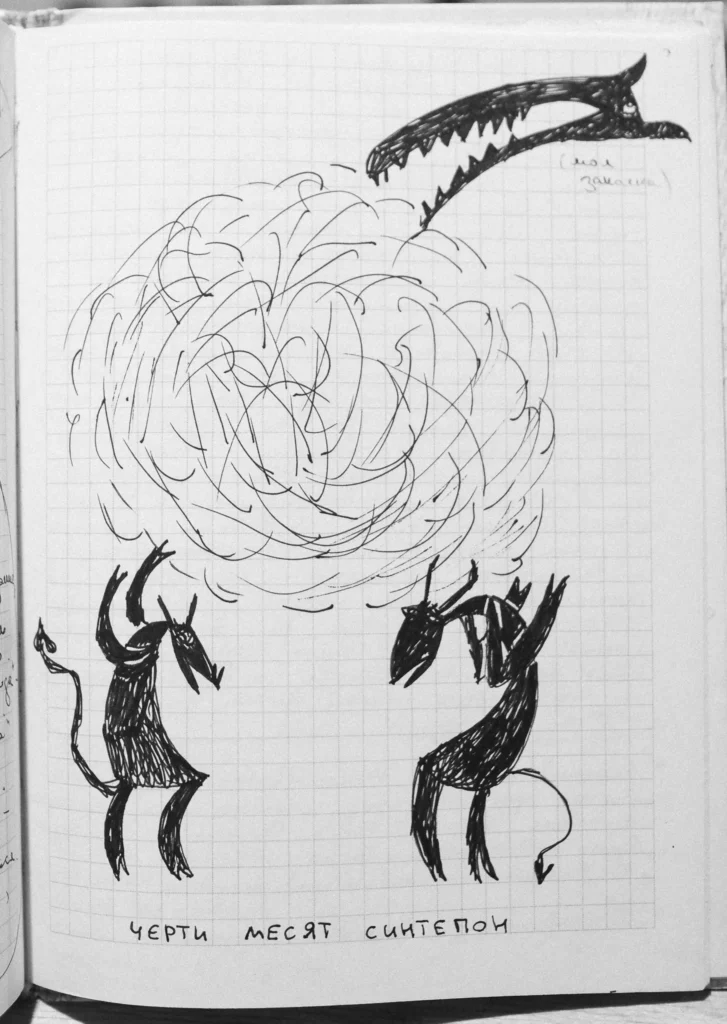
“devils knead synthetic padding”
My first monthly salary was 81 roubles. How many hours did I work? Nine hours, every day except Sunday. On Saturdays, you work less, you work until lunchtime, about five hours.
You can get sick, but you still have to prove it. What’s more, your fellow inmates will eat you alive, because when one person gets sick, the conveyor belt stops. Plus, some people tried to be independent of their relatives’ help of their own free will, and for them, their salary is important. They try to meet the quota. When someone gets sick, someone has to take over their duties, and the other person has their own duties to perform. In short, it’s a pain in the ass every time, so it’s better not to get sick. Even though the quota is damn crazy. And what’s more – it’s one thing on paper, but another in reality. The inspectors came to us and we looked at the official data, and there were completely different numbers, not the ones that they required of us. And we had to sew a thousand items a day. Well, everyone has their own quota — if you sew sleeves, it’s a thousand sleeves, if you sew pockets, it’s even more — three thousand. Basically, they do everything they can to prevent you from meeting your quota. It’s purely about earnings: the less they pay you, the more money stays with the company.
At first, I was on the fabric layering. My whole face was covered with purulent inflammations because that synthetic padding I was working with had been lying God knows where, God knows how. In our workshop we kept it on top of rusty iron industrial cabinets, they are two or three meters high. There were no ladders, but the synthetic padding was laying in there because there was no room in the workshop. We had to climb on the shelves, walk on the cabinets, and throw down and lift up these huge bales of synthetic padding. Your whole face is in this horror, and you could fall through the top of the cabinet full of holes. The first month was hard for me, I thought, damn, now I’ll fall off this cabinet, break my leg, lie in the hospital, read a book. Workplace injuries are very common because no one is trained.
They are immediately put to work on the sewing machine and taught through personal experience. A woman stitches her hands and it is considered a ‘minor industrial injury’. They may let you leave work early, but no one will give you sick leave for it. They stitch their hands, allergic attacks occur, Quincke’s oedema (a severe allergic reaction that can even cause suffocation, serious swelling of the throat).
I had to carry this synthetic padding from the cutting room. It was in another building, and you carry the synthetic padding you need for work. But my work is at a standstill then and the people who then sew your work are unhappy because they have to meet their quota. And without me, they won’t meet their quota. At the same time, if you don’t carry the bales that the forewoman told you to carry, the forewoman will also be unhappy. After a month and a half I was tired of this.
I always tried to communicate like a human being, and once I asked the women to let me work on marking out the fabric where there is no stupid synthetic padding. I was a terrible fabric layer, that’s why the forewoman agreed with my request. And the work was easier. I worked for 9 hours standing in the passageway because there was no separate space for marking out the fabric.
If the colony administration realizes that it is not meeting its order targets, they can impose overtime. Then you sign your consent in some tricky way, that is, first you work 12 hours a week, and then they bring you a piece of paper with a different date on it, and you sign that you agree to overtime. But you’ve already worked the hours, so of course you agree.
Searches, personal belongings
We had a wonderful woman who had already been in prison for seven years and therefore knew her rights very well. She refused to sign this piece of paper. There is something called collective responsibility: that means if one person undermines the regime, everyone is punished for it. In our colony, searches were the punishment. How does a search work? You sit there, drinking tea, reading a book. It’s a beautiful Sunday morning, as far as that’s possible — good morning, girls, we’re in prison. And then the officers come in and tell you to get the hell out. They rummage through all your bags and leave everything as it is. That is, they take out all your belongings. If they just came, they can, for example, not throw anything away. But if, for example, they find a third bra on you, they will fine you and throw it away. The bed must be made, according to the rules, like in the army. And they deliberately turn all the mattresses over, crumple up the linen and blankets. And after the search is over, you have to clean up all this mess super fast, because if they want to, they can take a screenshot and deliberately penalize you personally. And that is a step backwards on the way home if there is a lot left there. It is practically impossible to avoid the penalty; to do so, you have to work very hard or be a snitch.
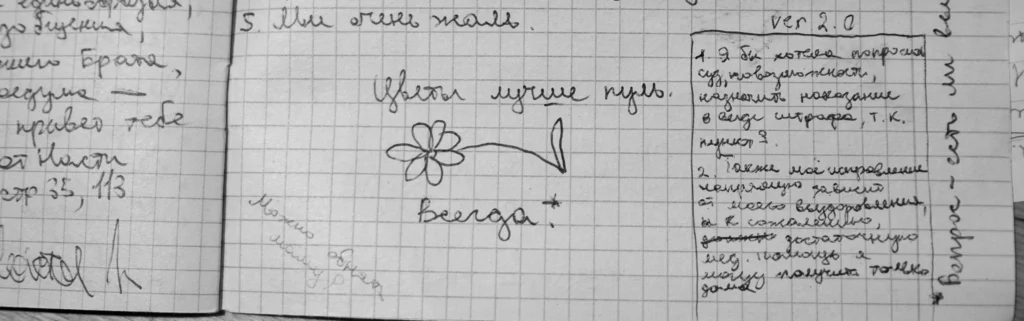
“Flowers are better than bullets. Always.”
What helped, what supported me
There was a moment, still in the pre-trial detention center, when I decided to move out of my cell. I am very sensitive to the issue of nationalism. In my cell, they started to discriminate Kazakh and Uzbek women, of whom there were many. They began to systematically pressure them, not letting them into the shower, and other things. This is a common practice among prisoners. And then I decided that I didn’t want to live like that. I went up to our senior cellmate and said, ‘so and so… I can complain to the investigator and leave, or I can leave with your permission, that is, you talk to the operative and I’ll leave, but I’m not going to put up with this bullshit.’ She spoke to the investigator, and I left, and all the Kyrgyz Kazakh women left too — it was a collective decision, out of solidarity. At that time, I was very proud that I did not lose heart and that I was supported.
Well, what kept me going? Writing in my diary and noticing little things really helped me. I mean, it helps you find something beautiful, something positive, to believe in yourself. Because everyone around you says you’re stupid, but you’re not stupid. And people probably helped too. Because, for example, I rescued a cat from the detention centre and it bit my finger, my fingernail. No one would take me to the medical centre to do anything for me. And people I didn’t even know, who had some understanding of ‘home’ medicine, revived my finger.
When they gather you for transport, when they take you somewhere, you literally have an hour to get ready. And it’s always unexpected. I don’t know how it is in men’s prisons, but in women’s it is customary to gather each other for the transfer. You are leaving, and whoever can give you something will give it to you. Some give leggings, others give something else. I was traveling in someone else’s jacket because something had happened to mine. They just gave me the jacket and said they would get another one. And this feeling of solidarity and unity in some kind of shared misfortune kept me going.
The prison system is one big problem — it doesn’t reform anyone. At the same time, women, for example, don’t get life sentences; they will be released in any case and will live in society. Most return to prison simply because they are so broken by the system that they cannot live outside it. It is an official statistic that you are likely to return there. This is because men, for example, receive more support from the outside world, while many turn away from women.
My parents and friends supported me and wrote letters. My mum actually fed me so much that I had to share it with the other inmates. I told her not to send so much, but she said, ‘It’s okay, I’ll feed other people’s daughters too.’ In general, yes, everyone, practically everyone, supported me. Of course, my close friend yelled at me when I first got out. It was very unpleasant, considering that she never wrote to me. But I considered her a close friend.
Now, however, with the passage of time and my resentment having subsided a little, I can understand her, not forgive her, but understand her.
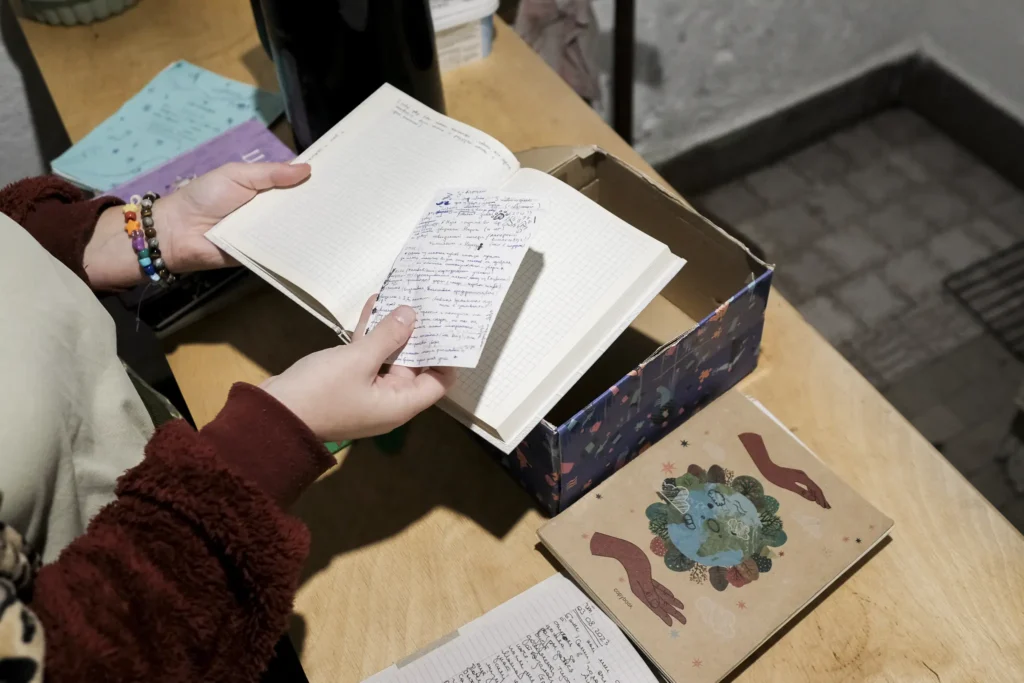
“I couldn’t take it anymore”
I left, and two months later, I couldn’t take it anymore. I had this overwhelming feeling as if I hadn’t returned home. And that’s a fact — because I never did. From the moment I went to the demonstration, from the moment I read the news on the morning of February 24, I will never return there again. Someone else came back instead. What’s more, when you come back from prison, it’s as if you’ve crossed the river of death twice. Well, that’s how I feel. It’s as if all your friends, all your relatives, have already mourned you, grieved for you, and then you come out alive, and destroy their worldview.
You don’t fit here any longer, they already have something else, something new, and you’re not part of it. It was very difficult. I’m much more withdrawn now than I used to be. If I used to reach out to people, try to keep in touch somehow, now I’m more in a position where if someone needs to, they’ll write to me, and if not, I’ll manage on my own. I go to a therapist, we touch on the subject of my imprisonment a little, but maybe we’ll talk about it more. I still don’t feel connected to the person I used to be. That’s probably the most upsetting thing, because I really liked myself back then. Well, not always, not my whole life, but the last few years before prison were the happiest of my life. And not feeling connected to that time is terribly upsetting. When your new life begins immediately with prison, it’s upsetting. Now, as a person, I have two years of freedom behind me and one or two years of prison. But who I was as a child, as a teenager — it’s as if it wasn’t me, as if it wasn’t mine, and that hurts because it’s as if it was taken away from me.
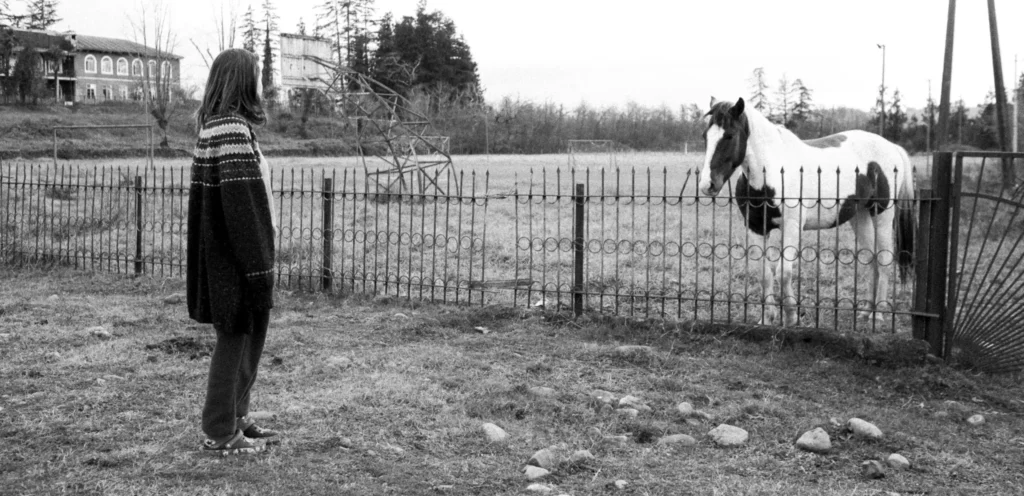
At the protest in February
I will say that I did not feel anything positive at that moment. Of course, there is a desire for justice and peace, but at that time, I only felt fear. What’s more, I consider myself a very cowardly person. Because I am sure that it is much more useful, much more dangerous, and much braver to protest and resist over a long period of time. Protest, that requires a plan of action and courage to continue when the risk is high and with each step the consequences for you become worse and worse. Today’s partisans, anonymous artists, invisible volunteers, they are all involved in spreading light, but over long distances. Not like me — a sprinter.
What I mean is that I consider myself a person who strives for justice, but I don’t consider myself brave. On the contrary, I consider myself very cowardly, because I did it out of some wild sense of horror. And I wanted to do something immediately, so that it would be once and for all. So that I wouldn’t have to be nervous anymore, wouldn’t have to look back, just take action and do it.
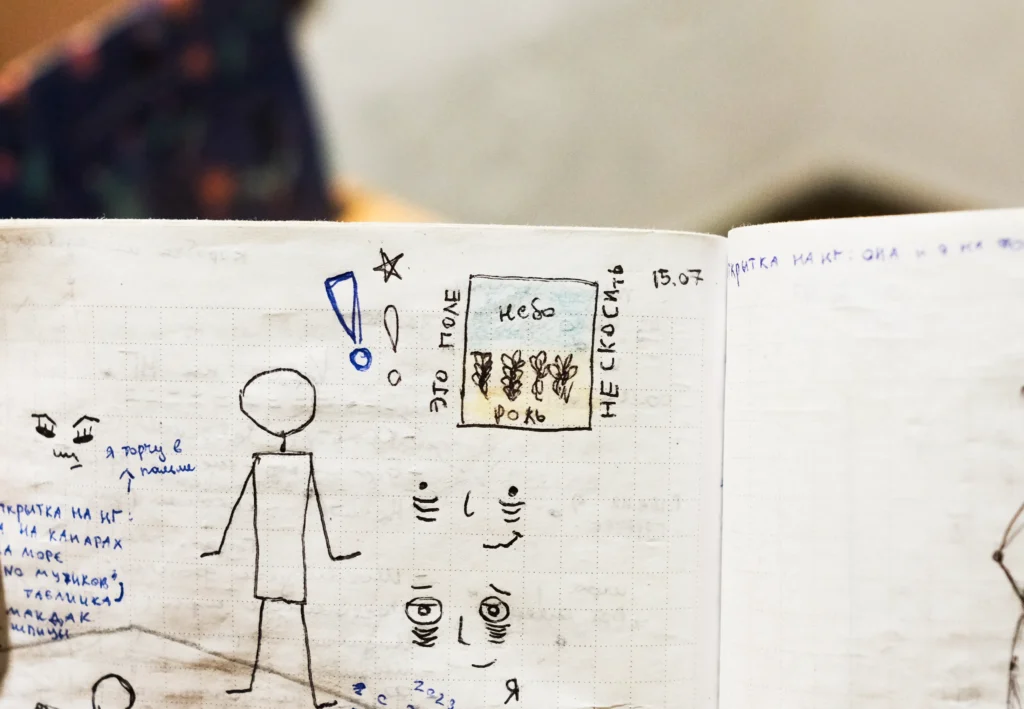
“This field can’t be mowed”. On blue color – “Sky” is written, on yellow – “rye”